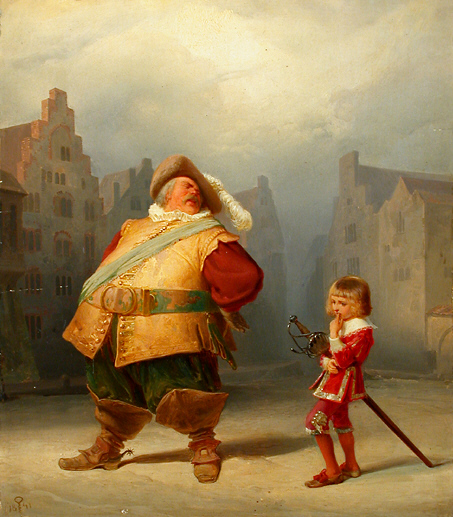
A director's job is visual storytelling. They have to find ways to tell the story to the actors, staff and audience using pictures. A director that ignores any of their potential visual palette (Aristotle's spectacle) should be taken out and shot. The visual palette includes costumes, sets, props, special effects, lighting, etc.
Historically Shakespeare told his story on a blank stage, with little set to distract the audience from the action. I am doing the same. But with less set (and no applicable lighting until more than half way through the play), attention must be spent on the other elements, especially costumes.
An examination of Shakespeare and his comedy The Merry Wives of Windsor
Showing posts with label Fairies. Show all posts
Friday, July 1, 2011
Tuesday, May 31, 2011
Show Concepts: Pros and Cons
Okay, so I have been struggling/juggling back and forth between two concepts for Merry Wives of Windsor. On one hand, a classic look and setting could be quite nice for this play and on the other hand, a transposition to the American West/Frontier could work exceptionally well. When I last updated the blog I had pretty much settled my mind on one specific concept and then I went down to the park and everything shifted again.
I want to take a few minutes to lay out the pros and cons of each concept (Traditional vs. Old West).
Wednesday, April 27, 2011
How Do I Figure Out Who The Merry Wives of Windsor Are?
When I am picking a show to direct, I pretty much follow the questions as I have been asking them this week. I read a bunch of scripts and try to figure out why I like a specific script. I give it another read to find out what it's all about, discovering if it's a story I want to tell.
Then I tackle the big three: when, who and where. The answers to these three questions determine if it goes from a story I want to tell to a story I can tell.
While I normally start with "who", with Shakespeare "when" is the big factor. I try to find that hook that will help my audience get into the story and first see if the story can be set in modern times. I've set Two Gentlemen of Verona in a skate park, and Romeo and Juliet at a rave. I was all set to put Love's Labour's Lost in a fraternity house when I heard some Shakespeare purists in town were upset that I was always updating Shakespeare to the modern era. So I decided to show them, and I set it in the late 16th century and it was a mistake. The production had some glorious tech elements and some of the finest performances from my actors, but the audience had a visual hurdle they couldn't overcome in a single viewing.
"Where" is so closely tied to "when" and ideas do formulate right away within the second read, but first I have to determine if I have the personnel to do the show. And in order to do that, I have to know the job descriptions for each role. This does not mean that I cast the show this far in advance. I always wait until the auditions for that. Instead, I start doing what I call a breakdown of the script, so that I can get to know the characters better.
Then I tackle the big three: when, who and where. The answers to these three questions determine if it goes from a story I want to tell to a story I can tell.
While I normally start with "who", with Shakespeare "when" is the big factor. I try to find that hook that will help my audience get into the story and first see if the story can be set in modern times. I've set Two Gentlemen of Verona in a skate park, and Romeo and Juliet at a rave. I was all set to put Love's Labour's Lost in a fraternity house when I heard some Shakespeare purists in town were upset that I was always updating Shakespeare to the modern era. So I decided to show them, and I set it in the late 16th century and it was a mistake. The production had some glorious tech elements and some of the finest performances from my actors, but the audience had a visual hurdle they couldn't overcome in a single viewing.
"Where" is so closely tied to "when" and ideas do formulate right away within the second read, but first I have to determine if I have the personnel to do the show. And in order to do that, I have to know the job descriptions for each role. This does not mean that I cast the show this far in advance. I always wait until the auditions for that. Instead, I start doing what I call a breakdown of the script, so that I can get to know the characters better.
Subscribe to:
Posts (Atom)