Showing posts with label Host of the Garter. Show all posts

Monday, June 27, 2011

Host of the Garter

The Star and Garter Inn
The Host of the Garter Inn is an interesting character.  The owner and operator of the Garter, Windsor's pub, the Host is affable, warm, and a bit of a prankster.  I'm most excited because this is a role that could be played by a woman, increasing the adult principal women's roles to four.

One of the most interesting things about the Host is the very distinct speech pattern.  There's a lot of repetition of phrases or entire sentences within a speech.  There's also a lot of talking in short phrases, and even more of hyperbolic talking.  I wonder if Shakespeare patterned the speech pattern after the actual Host of the Garter when he was writing the play; I've not encountered such a distinct speaking pattern in Shakespeare before.

Saturday, June 4, 2011

Dr. Caius

The other side of Sir Hugh Evans, our Welsh pastor, is Dr. Caius, our French doctor.  Shakespeare makes more pointed commentary about foreigners with this character and about the utter ridiculousness/futility of the medical practice at the turn of the 17th century.

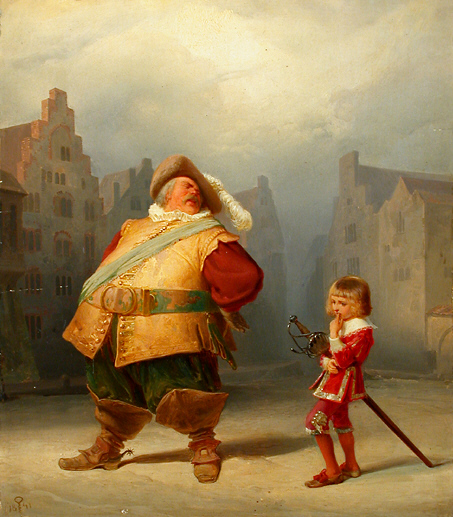
To catalog all of the ways that Dr. Caius is the butt of the joke would be take too much time and bandwith.  He is foppish but in a far more masculine way than Slender.  He is fiery, quick-tempered, and extremely passionate about the mundane.  He practices his fencing on children.

The actor's struggle becomes to find the point right before it goes over the top. Careful playing on this point will go a long way to make the performance and show extraordinary.


Friday, June 3, 2011

Sir Hugh Evans

Sir Hugh listens
Sir Hugh Evans is a bit of a conundrum.  Shakespeare seems to want it two ways.  He mercilessly makes fun of the Welsh by exaggerating Evans' accent, but he never really goes after them.  He also want Sir Hugh to be the mender of souls, but is careful when attacking the man's profession or station.

Evans is a parson from Wales, and as such quite a few jokes come from his very thick accent.  He is a point of ridicule, but not nearly as much the French Dr. Caius.  There seems to be little real mockery towards the Welsh in the script, unlike the French who take it full on in the face.  Instead, Evans is made ridiculous by the tenants of his own character.

He talks in circles, and at times contradicts himself within the course of a single speech.  The playing of this is key.  It needs to make sense to him and no one else; a sort of Monty Python-esque tribute.

Friday, April 29, 2011

So...Who Are The Merry Wives of Windsor?

This took a little bit longer than I expected.  Essentially there are 19 principal roles, with three of them going to children.  Figuring out the relationships and what makes the characters tick is a time consuming process.  Especially when there are 6 principals who do not have a lot of lines but a lot of stage time.

So let's dig right in and get to the cast breakdown. 

Wednesday, April 27, 2011

How Do I Figure Out Who The Merry Wives of Windsor Are?

When I am picking a show to direct, I pretty much follow the questions as I have been asking them this week.  I read a bunch of scripts and try to figure out why I like a specific script.  I give it another read to find out what it's all about, discovering if it's a story I want to tell.

Then I tackle the big three:  when, who and where.  The answers to these three questions determine if it goes from a story I want to tell to a story I can tell. 

While I normally start with "who", with Shakespeare "when" is the big factor.  I try to find that hook that will help my audience get into the story and first see if the story can be set in modern times.  I've set Two Gentlemen of Verona in a skate park, and Romeo and Juliet at a rave.  I was all set to put Love's Labour's Lost in a fraternity house when I heard some Shakespeare purists in town were upset that I was always updating Shakespeare to the modern era.  So I decided to show them, and I set it in the late 16th century and it was a mistake.  The production had some glorious tech elements and some of the finest performances from my actors, but the audience had a visual hurdle they couldn't overcome in a single viewing.

"Where" is so closely tied to "when" and ideas do formulate right away within the second read, but first I have to determine if I have the personnel to do the show.  And in order to do that, I have to know the job descriptions for each role.  This does not mean that I cast the show this far in advance.  I always wait until the auditions for that.  Instead, I start doing what I call a breakdown of the script, so that I can get to know the characters better.

Tuesday, April 26, 2011

What is The Merry Wives of Windsor?

The Merry Wives of Windsor is one of Shakespeare's middle era comedies which I am going to say was written in 1600.  A far more detailed explanation for my choosing of that date will come in the immediate future.  There is much debate about the actual year of authorship, as there is with most dates for anything Shakespeare related.

I am quite in love the idea that this play was written at the request of Elizabeth I because she enjoyed the character of Falstaff so much and wanted to see a play with him in love. 

The play focuses on the oafish knight Sir John Falstaff and his attempts to woo two married women so that he may be a "kept" man.  A secondary plot revolves around Anne Page, the eldest daughter of one of the women Falstaff is wooing, and the three men that are vying for her affection. 

The comedy is broad, perhaps the broadest of any of the Shakespeare plays, and oftentimes borders on farcical slapstick.  Many contemporary scholars/directors liken it to a sitcom; one of the popular "adapted settings" is that of a 1950's/early 60's sitcom setting.