Showing posts with label class struggle. Show all posts

Saturday, June 4, 2011

Dr. Caius

The other side of Sir Hugh Evans, our Welsh pastor, is Dr. Caius, our French doctor.  Shakespeare makes more pointed commentary about foreigners with this character and about the utter ridiculousness/futility of the medical practice at the turn of the 17th century.

To catalog all of the ways that Dr. Caius is the butt of the joke would be take too much time and bandwith.  He is foppish but in a far more masculine way than Slender.  He is fiery, quick-tempered, and extremely passionate about the mundane.  He practices his fencing on children.

The actor's struggle becomes to find the point right before it goes over the top. Careful playing on this point will go a long way to make the performance and show extraordinary.


Friday, June 3, 2011

Sir Hugh Evans

Sir Hugh listens
Sir Hugh Evans is a bit of a conundrum.  Shakespeare seems to want it two ways.  He mercilessly makes fun of the Welsh by exaggerating Evans' accent, but he never really goes after them.  He also want Sir Hugh to be the mender of souls, but is careful when attacking the man's profession or station.

Evans is a parson from Wales, and as such quite a few jokes come from his very thick accent.  He is a point of ridicule, but not nearly as much the French Dr. Caius.  There seems to be little real mockery towards the Welsh in the script, unlike the French who take it full on in the face.  Instead, Evans is made ridiculous by the tenants of his own character.

He talks in circles, and at times contradicts himself within the course of a single speech.  The playing of this is key.  It needs to make sense to him and no one else; a sort of Monty Python-esque tribute.

Robin, Simple and Rugby

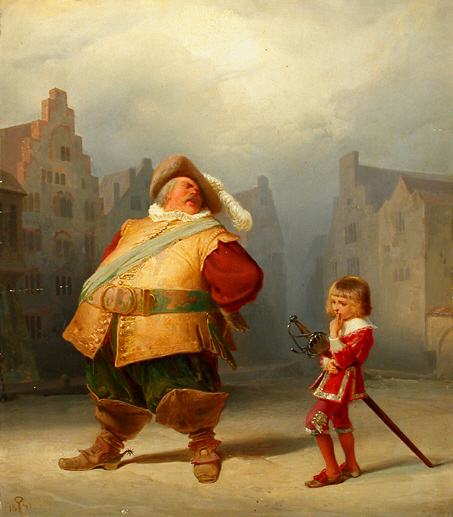
Falstaff and Robin
Another of the many "threes" in Merry Wives, the young servants Robin, Peter Simple and John Rugby serve many purposes in the play.  They obviously serve their masters and do their bidding; they serve Shakespeare's literary purpose of having the lower class demonstrate the folly of the upper class; they serve our production's purpose of having significant roles for children under the age of 13.