Showing posts with label Henry IV Part 2. Show all posts

Saturday, June 4, 2011

Justice Shallow

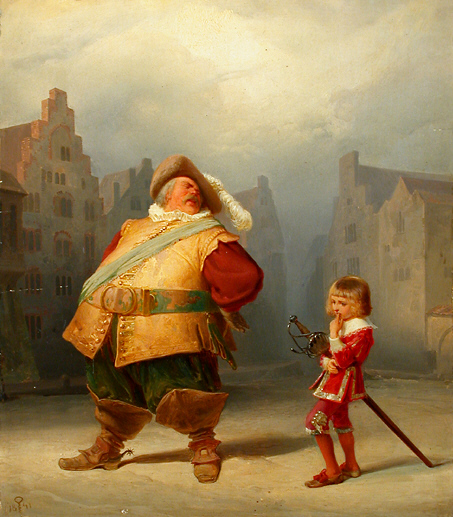
Justice Shallow first appears in Henry IV, Part 2 as an old friend of Falstaff's.  In this play they have a very warm relationship.  Falstaff owes him a thousand pounds and when Henry IV dies at the end of the play, Falstaff asks Shallow to follow him to the castle.  Falstaff believes that his drinking buddy Prince Hal, now King Henry V, will reward him for his long devotion and friendship.  Instead the new King Henry ignores Falstaff, leaving the folly of youth behind, and devastating the fat knight.

Shallow witnesses this and, rather than press his friend for the money, he tries to forgive him half of the debt and asks Falstaff to come to his home in the country [Windsor].  Falstaff agrees but says that he will pay him what he owes.

Friday, June 3, 2011

Robin, Simple and Rugby

Falstaff and Robin
Another of the many "threes" in Merry Wives, the young servants Robin, Peter Simple and John Rugby serve many purposes in the play.  They obviously serve their masters and do their bidding; they serve Shakespeare's literary purpose of having the lower class demonstrate the folly of the upper class; they serve our production's purpose of having significant roles for children under the age of 13.

Fenton

Fenton.  What a sap.

Fenton says himself that he first wooed Anne to get at her father's money.  But then he fell in love with her.  And oh, how he fell.

Wednesday, June 1, 2011

Bardolph, Pistol and Nym

Falstaff, Nym, Pistol and Bardolph enter the Garter
Of the many "threes" in Merry Wives of Windsor, Bardolph, Pistol and Nym are the most intriguing and most remembered.  Essentially Falstaff's entourage, the men are as different as from each other as they could be.  They also have very different back stories.

I often say that productions are only as strong as the ensemble, and while that is true, for this script, these three take on part of that focus.  They each serve a different function for Falstaff and for the plot.  If there isn't careful delineation between the three, all is lost for the entire production.

Tuesday, April 26, 2011

When is The Merry Wives of Windsor?

When you consider the time of The Merry Wives of Windsor, there are really three things you are considering:
            1. The setting of the script;
            2. The time we are setting this production;
            3. The time the script was written.
With most plays you don't necessarily consider the second point, but because Shakespeare is so "hard to understand" directors sometimes take great strains to translate the story to a setting that will give their audience another "in" to the script.  I wholeheartedly believe that there is nothing wrong with this.

Purists (oh, how I loathe them) cry fowl when directors update a Shakespeare script.  They think that it is a bespoulment of the good works of a master.  I would say to them The Lord Chamberlain's Men and The King's Men did the exact same thing during Shakespeare's time.  They kept their actors in modern, Elizabethan dress, especially for the history plays.  Why should we be any different?