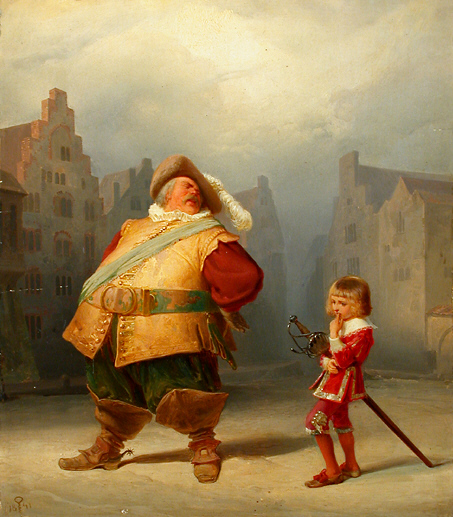
A director's job is visual storytelling. They have to find ways to tell the story to the actors, staff and audience using pictures. A director that ignores any of their potential visual palette (Aristotle's spectacle) should be taken out and shot. The visual palette includes costumes, sets, props, special effects, lighting, etc.
Historically Shakespeare told his story on a blank stage, with little set to distract the audience from the action. I am doing the same. But with less set (and no applicable lighting until more than half way through the play), attention must be spent on the other elements, especially costumes.
An examination of Shakespeare and his comedy The Merry Wives of Windsor
Showing posts with label Old West. Show all posts
Friday, July 1, 2011
Friday, June 3, 2011
Robin, Simple and Rugby
![]() |
| Falstaff and Robin |
Tuesday, May 31, 2011
Show Concepts: Pros and Cons
Okay, so I have been struggling/juggling back and forth between two concepts for Merry Wives of Windsor. On one hand, a classic look and setting could be quite nice for this play and on the other hand, a transposition to the American West/Frontier could work exceptionally well. When I last updated the blog I had pretty much settled my mind on one specific concept and then I went down to the park and everything shifted again.
I want to take a few minutes to lay out the pros and cons of each concept (Traditional vs. Old West).
Thursday, May 5, 2011
Where is The Merry Wives of Windsor?
The "where" of a play helps fine tune a production and can make all the difference. We have all seen productions where not nearly enough was done to physically manifest the storytelling; you get a bunch of people saying lines with feeling but there is no sense of place and the play just sits there. I've also seen productions (Webber's The Phantom of the Opera, for example) where the settings overwhelm the storytelling, minimizing it.
Finding that delicate balance is one of the chief jobs of a director as he is responsible for the visual storytelling of a production. Too often, a director lets this slide, and the production is hurt for it. A really good technical director is a must for any director--one that understands visual storytelling and does what he or she can to make the director's visions a reality.
The director must have a clear vision and be able to articulate that vision. He needs to not only set the course but be willing to take input that will make the vision better. A director that sets himself up to honor only one point of view fails not only the production but the process and the craft.
With Merry Wives of Windsor we need to examine the specific places that the script calls for and then figure out how we might adapt them for our production.
Finding that delicate balance is one of the chief jobs of a director as he is responsible for the visual storytelling of a production. Too often, a director lets this slide, and the production is hurt for it. A really good technical director is a must for any director--one that understands visual storytelling and does what he or she can to make the director's visions a reality.
The director must have a clear vision and be able to articulate that vision. He needs to not only set the course but be willing to take input that will make the vision better. A director that sets himself up to honor only one point of view fails not only the production but the process and the craft.
With Merry Wives of Windsor we need to examine the specific places that the script calls for and then figure out how we might adapt them for our production.
Subscribe to:
Posts (Atom)