
Monday, June 20, 2011
Rehearsal Report--6/16


Rehearsal Report--6/15

Wednesday, June 15, 2011
Verse vs. Prose--Playing the Punctuation

He usually makes prose the language form of the commoners or the lower class in his plays, and almost every character in Merry Wives is firmly in the middle class. In fact, Falstaff is the person of the highest class in the play, but unless he is quoting a poet, he never speaks in verse. Prose sounds more naturalistic, more common than verse, primarily because it doesn't stick to the strict form of blank verse. There is also a decided lack of heightened language in the prose sections.
Verse vs. Prose: How to Read the Verse--UPDATED

Merry Wives of Windsor is atypical of most of Shakespeare's plays as it is mostly written in prose form. I think Much Ado About Nothing may be the only play to have even less verse. Historically, verse was the common form of playwriting in the Elizabethan era. Shakespeare was a radical to use as much prose as he did.
Tuesday, June 14, 2011
Shakespeare's Language

He doesn't. It's modern English and if you have ever sat through a pre-Renaissance English class, then you know right away that old English is almost incomprehensible. Granted Shakespeare's language may the beginnings of modern English, but it's still Modern English.
First Read-Through

One of the things that was apparent was how strong the acting company really is. We have a nice collection of actors in all areas of the company who are willing and wanting to give their all. That's an exciting thing to witness and thrilling to be a part of.
Friday, June 10, 2011
Stuff Happens

I have never had the luxury of a week between auditions and first rehearsal. I am used to going just a three days at most. Well, it looks like I am back to just having three days, or less. There was an unexpected death in our immediate family. While we knew this was coming, we thought that we still had a few months at the very least. Needless to say Merry Wives has taken a back seat.
Monday, June 6, 2011
Production Meeting--6-6-11

Auditions

As a director the audition period marks a critical juncture on the production of the show: you get to see if the plans you had been formulating will work. Sometimes hearing the words spoken aloud tells you more than you can ever imagine than when just reading a text. This happens with every show, regardless of material. It's liberating and invigorating as a director to see the words live in front of you. New doorways open and others sometimes close.
Saturday, June 4, 2011
William Page
 |
| Shakespeare as a child? |
Say "vocative case" out loud but change the opening consonant to an f-sound like Evans does. Naturally, Quickly's reaction is anything but clean. It's the lowest of low comedy but it is funny.
I am toying with cutting this scene, not because the f-word is slyly bandied about but because it halts the forward movement of the show in three ways. One, it has nothing to do with any other plot and comes fairly late in the show. Two, the language and the jokes used could be lost on modern audiences. And three, it may not have been written by Shakespeare anyway.
If I do cut it, I should find something important for William to do. Perhaps a feature in the fairy dance/song at the end of the show. He will be featured as one of the Page children in the beginning, but there may need to be a few more Page children, thereby lessening his impact.
Costume Notes
--Simple prairie dress or sailor dress is preferred
--Fairy costume
Justice Shallow

Shallow witnesses this and, rather than press his friend for the money, he tries to forgive him half of the debt and asks Falstaff to come to his home in the country [Windsor]. Falstaff agrees but says that he will pay him what he owes.
Dr. Caius
 The other side of Sir Hugh Evans, our Welsh pastor, is Dr. Caius, our French doctor. Shakespeare makes more pointed commentary about foreigners with this character and about the utter ridiculousness/futility of the medical practice at the turn of the 17th century.
To catalog all of the ways that Dr. Caius is the butt of the joke would be take too much time and bandwith. He is foppish but in a far more masculine way than Slender. He is fiery, quick-tempered, and extremely passionate about the mundane. He practices his fencing on children.
The actor's struggle becomes to find the point right before it goes over the top. Careful playing on this point will go a long way to make the performance and show extraordinary.
Friday, June 3, 2011
Sir Hugh Evans
| |
| Sir Hugh listens |
Evans is a parson from Wales, and as such quite a few jokes come from his very thick accent. He is a point of ridicule, but not nearly as much the French Dr. Caius. There seems to be little real mockery towards the Welsh in the script, unlike the French who take it full on in the face. Instead, Evans is made ridiculous by the tenants of his own character.
He talks in circles, and at times contradicts himself within the course of a single speech. The playing of this is key. It needs to make sense to him and no one else; a sort of Monty Python-esque tribute.
Robin, Simple and Rugby
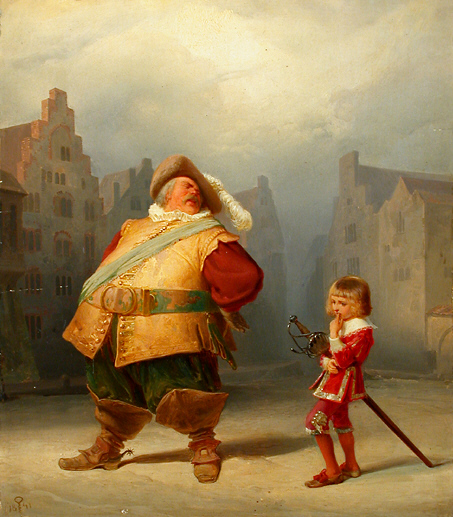 |
| Falstaff and Robin |
Fenton

Fenton says himself that he first wooed Anne to get at her father's money. But then he fell in love with her. And oh, how he fell.
Anne Page

At first blush she seems just the typical ingenue: young, beautiful and destined for marriage. And when you examine just her lines she doesn't have a lot to say. She doesn't want to marry Dr. Cauis; she thinks Slender is a joke; she seems to have chosen Fenton. But why Fenton?
Wednesday, June 1, 2011
Bardolph, Pistol and Nym
 |
| Falstaff, Nym, Pistol and Bardolph enter the Garter |
I often say that productions are only as strong as the ensemble, and while that is true, for this script, these three take on part of that focus. They each serve a different function for Falstaff and for the plot. If there isn't careful delineation between the three, all is lost for the entire production.
Tuesday, May 31, 2011
Show Concepts: Pros and Cons

 Okay, so I have been struggling/juggling back and forth between two concepts for Merry Wives of Windsor. On one hand, a classic look and setting could be quite nice for this play and on the other hand, a transposition to the American West/Frontier could work exceptionally well. When I last updated the blog I had pretty much settled my mind on one specific concept and then I went down to the park and everything shifted again.
I want to take a few minutes to lay out the pros and cons of each concept (Traditional vs. Old West).

I want to take a few minutes to lay out the pros and cons of each concept (Traditional vs. Old West).
Wednesday, May 25, 2011
General Update

Thursday, May 5, 2011
Where is The Merry Wives of Windsor?

Finding that delicate balance is one of the chief jobs of a director as he is responsible for the visual storytelling of a production. Too often, a director lets this slide, and the production is hurt for it. A really good technical director is a must for any director--one that understands visual storytelling and does what he or she can to make the director's visions a reality.
The director must have a clear vision and be able to articulate that vision. He needs to not only set the course but be willing to take input that will make the vision better. A director that sets himself up to honor only one point of view fails not only the production but the process and the craft.
With Merry Wives of Windsor we need to examine the specific places that the script calls for and then figure out how we might adapt them for our production.
Subscribe to:
Posts (Atom)